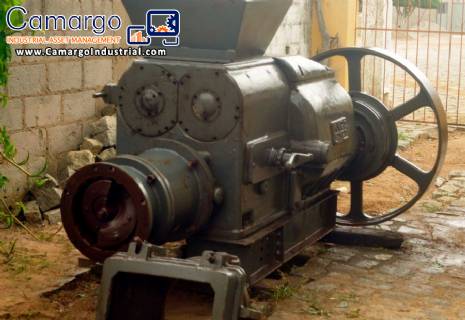
Ceramic extruders, also known as maromba brick extruders, are equipment used in the production of bricks and ceramic pieces through the extrusion process. Extrusion is a method of forming materials where a ceramic mass is forced through a die to obtain a continuous profile, such as the shape of a brick.
What is it for:
These extruders are designed specifically for the manufacture of ceramic bricks, commonly used in construction. They allow large-scale production of bricks in an efficient and standardized way.
How it works:
The basic operation of a ceramic extruder involves the following steps:
Preparation of the Ceramic Mass: The clay or ceramic mixture is prepared with the appropriate consistency for extrusion. This usually involves adding water and other additives to obtain the necessary plasticity.
Feeding into the Extruder: The prepared ceramic mass is fed into the extruder, where it is compressed and forced through a die with the desired shape.
Product Formation: The extruder die determines the profile of the final product. In the case of maromba bricks, the matrix provides the specific shape of the brick. The extruded piece is cut into desired lengths, forming individual bricks.
Drying and Firing: Extruded bricks are subjected to drying processes to remove moisture and are then fired in kilns to achieve the desired strength and durability.
Types of Maromba Ceramic/Brick Extruders:
There are different types of ceramic extruders, each adapted for specific applications. Some common types include:
Vacuum Extruders: They use vacuum to compact and extrude the ceramic mass, resulting in denser and more uniform products.
Semi-Automatic and Automatic Extruders: They vary in levels of automation, from semi-automatic models, which require more manual intervention, to fully automatic extruders, which perform most of the steps automatically.
Piston Extruders: They use a hydraulic piston to press the ceramic mass through the matrix, being suitable for large-scale production.
The choice of extruder type depends on the specific production needs, the type of ceramic part to be manufactured and the desired level of automation. |