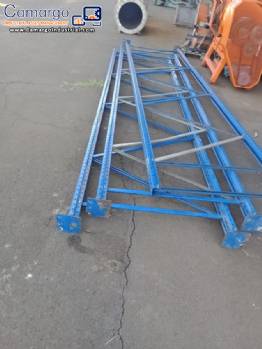
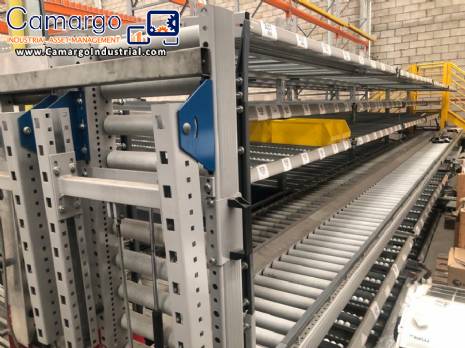
Pallet racks are storage systems used in warehouses and distribution centers to organize and store goods on pallets. They play a crucial role in operational efficiency and space optimization. Let’s explore what they’re for, how they work, and some common types of pallet trucks:
What is it for:
Efficient storage: Pallet trucks allow vertical storage of pallets, maximizing available warehouse space.
Easy access: They facilitate quick access to products, as each pallet can be easily located and removed when necessary.
Organization: Allows a structured organization of products, improving efficiency in stock management.
Damage reduction: By facilitating the movement of products, they contribute to reducing damage during storage.
How it works:
Pallet racks usually consist of a vertical support structure (columns) and horizontal beams (rails) on which pallets are placed.
Pallets are loaded and unloaded by forklifts or other material handling equipment.
The height and width between pallet truck levels can be adjusted to accommodate different load sizes.
There are pallet truck systems that use gravity to move pallets, such as "gravity flow" or "drive-in/drive-thru" systems, in which forklifts can enter the aisles between the racks.
Types of pallet trucks:
Selective pallet trucks: These are the most common and offer direct access to each pallet. Suitable for warehouses where there is a variety of fast-moving products.
Drive-in/drive-thru: Allows deep storage of pallets, facilitating the storage of large quantities of the same product. At the drive-in, the entrance and exit are on the same side, while at the drive-thru, the entrances and exits are on opposite sides.
Push-back pallet trucks: These work with carts that move on rails and push pallets backwards as new pallets are loaded. This maximizes storage space.
Cantilever pallet trucks: Designed to store long items such as pipes or bars. They have horizontal arms that support the loads.
Choosing the type of pallet truck depends on the specific needs of the warehouse, such as the type of products stored, stock rotation and space availability. |